Connections 79

You can now read the latest issue of Connections at the SCIS website.

Teacher librarians as cultural change agents

Dianne Oberg discusses the concept of school culture. She believes the very essence of the work of teacher librarians – improving teaching and learning – requires that they work within the culture of the school and that they also work to change the culture of the school.
Online referencing generator

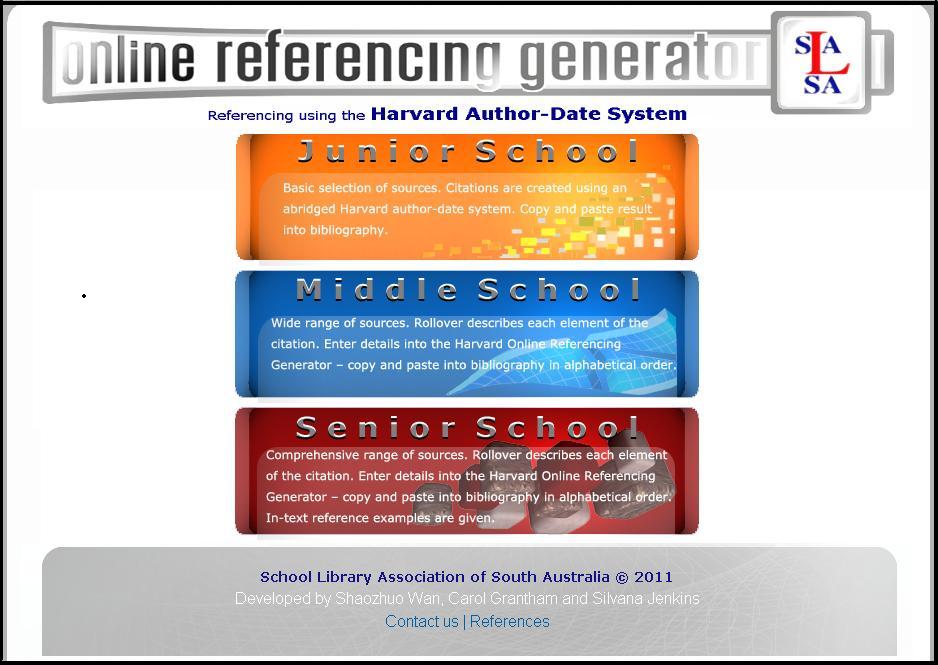
Online referencing generator home page
SLASA online referencing generator

This article by project managers Carol Grantham and Silvana Jenkins, describes the online referencing generator project undertaken by the School Library Association of South Australia (SLASA). It outlines the project’s rationale, the development process, the partnership with the University of South Australia and how schools are using this online Harvard referencing tool.

Digital literacy across the curriculum

This article has been prepared from edited extracts of Digital Literacy across the Curriculum, a handbook developed by Futurelab. The handbook is aimed at educational practitioners and school leaders, in both primary and secondary schools, who are interested in creative and critical uses of technology in the classroom.

Dewey Decimal Classification – Edition 23

Pam Kadow, SCIS Cataloguing Team Leader summarises the main updates and changes to subject categories in the new 23rd edition of the Dewey Decimal Classification, being used by SCIS from September 2011.
More detailed information on number relocations, discontinuations and re-used numbers is available at
www.oclc.org/us/en/dewey/versions/print.

Print the complete issue of Connections 79, term 4 2011

Connections 78

You can now read the latest issue of Connections at the SCIS website.

Seven strategies to develop your advocacy toolkit

Strategies
Strategies by Boris Drenec CC-by-nc-sa

Karen Bonanno provides a series of advocacy activities to help school library staff influence policy, advising that to bring about change requires consistent and persistent effort to shift perceptions. She advocates maintaining regular positive activity supported by strategies such as identifying a memorable message, capturing killer statistics, gathering startling facts and statements and leveraging the network.

Personal learning network put to great advantage

Leonie Dyason and Rachel Fidock, teacher librarians from Mooroopna Secondary College (MSC) share their experiences of the Personal Learning Network (PLN) program, run by the State Library of Victoria (SLV) and the School Library Association of Victoria (SLAV). They outline how their practice has changed through application in the library, in team teaching and in troubleshooting. A list of useful Web 2.0 tools is provided.

Ten reasons why Google can’t replace learning!

Bev Novak questions the idea that searching can replace learning. Her ten questions challenge teachers and parents to consider the distinction between information and knowledge, and to refine what they mean by learning and how learning is best achieved. This article is reprinted from her NovaNews blog.

The evolving role of the school library and information centre in education in digital Europe

This article outlines research by Dr Helen Boelens into the role of school libraries in digital Europe, using the Kalsbeek Information Literacy Matrix (KILM).
A poster: ‘Read’ in European language terms is provided for download.

The Hub: campaign for quality school libraries in Australia

This article by Georgia Phillips provides an update on the activities of the Hub campaign for quality school libraries in Australia, following the release of the Australian Government’s report into school libraries and teacher librarians in Australian schools. It includes an overview of the current state of school library staffing in Australian state and territory government schools.

Print the complete issue of Connections 78, term 3 2011

Connections 77

You can now read the latest issue of Connections online. Copies have been mailed to all Australian schools.

Teacher librarians and the networked school community

Everyone knows everyone!
Everyone knows everyone!, image by arianamedstudent, licence: CC-by

Mal Lee and Lyn Hay present their view of the evolution facing schools and the role of the information centre professional.

Schooling worldwide is in the process of evolving from a traditional paper-based operational mode to one that is digital and networked. The opportunities being opened daily for the astute, proactive information professional prepared to embrace and lead ongoing change are immense.

Natural disasters and disaster plans

In recent months many areas of Australia and New Zealand have experienced very serious natural disasters. These natural disasters have had significant impact on schools in the affected areas. Many schools continue to operate in difficult conditions or are temporarily operating off site. This article raises the timely question of school library disaster plans.

Behaviour

Adam Le Good explores the reasons behind unacceptable behaviour (of students and staff) and what we can do to minimise its effect.

Schools and social media

An article adapted from Denis Masseni’s report of a 2010 survey of Victorian school principals entitled ‘Why schools are spooked by social media‘. It discusses the benefits of social media for schools and security and protection issues.

From little things big things grow

The fifth instalment of Nigel Paull’s account of a new BER library at South Grafton Public School, New South Wales in which he describes the enthusiastic response of students to the finished library.

Print complete issue of Connections 77, term 2 2011

Subscribe By Email

Get every new post delivered right to your inbox.

This form is protected by reCAPTCHA and the Google Privacy Policy and Terms of Service apply.